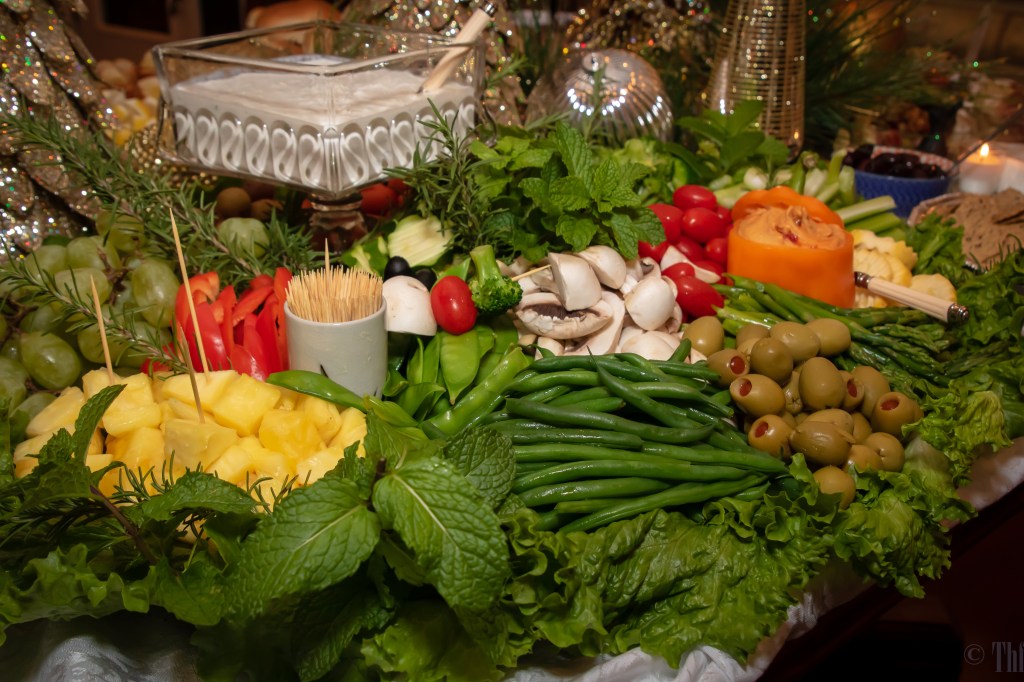
Hover over the table with your friends. Everyone is commenting about how pretty the layout is. Stab an olive with a twice-used toothpick. It’s about saving the forests after all. Or glance furtively around the table. No one is looking. Grab one between thumb and index finger. Double dip the cheese melt with a cold green bean. No one noticed that first bite. Dip the other end. Hands are clean and dry. Now reach across the table and shake hands with a friend you haven’t seen in at least a week or two. On the return from that greeting, swoop down and land a chunk of sweet pineapple.
Moving on to the new year.
The crowd is still forming. Scotch eggs, maple-iced doughnuts, French roast coffee, artichoke dip, veggies, nuts, wassail. Before the morning passes, sixty or so friends will crowd in around the table, serve a plate, exchange greetings, and tell tales of the year gone by, hopes for the year ahead and mostly true stories from all the walks of community life.
Our love is manifest in food and words.
How will we greet 2021? There is virtually no safe and healthy way to do it the way we have been doing it. But January is so far in the future. We can hope.
Dads gave their sons lessons on the proper handshake. The lesson included the rule of never offering your hand to a lady unless she offered hers first. It emphasized the importance of a firm grip, but never a bone crusher. And that one should never, ever linger too long hand in hand.
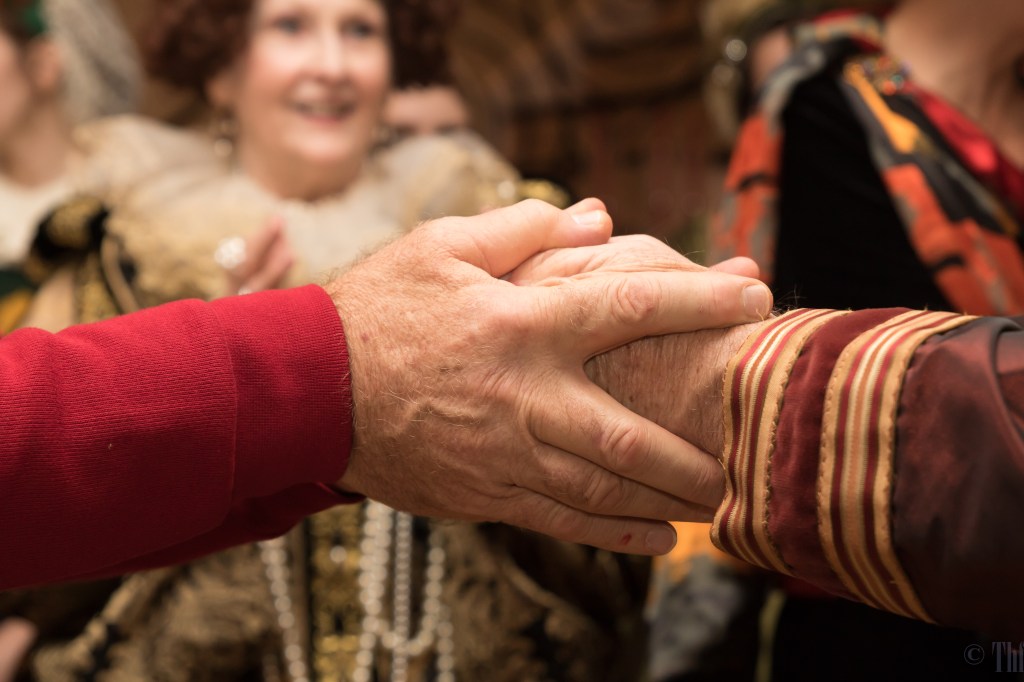
The Queen looks on as the steward of Warwick Castle shares the warm embrace of hands with the master of the house.
By the time I was out of college, ladies (actually, they preferred to be called women by that time) offered their hands in greeting without forethought or remorse. It was so commonplace in our social life that we never thought much about its disease transmitting potential.
But then there was coronavirus and COVID-19. The gentleman’s warmest greeting was suddenly a life-threatening gesture. By the time we went into lockdown on March 13, I had already mastered the elbow bump but found only a couple of folks who knew exactly how to respond to my apparent act of aggression. Since then, I have not been around enough people to even think about elbow bumps, handshakes, cheek kisses, or anything else. At most, I offer a weak quasi-military salute. It works for most people.
Perhaps it will be the death of the handshake. Will anyone even remember the custom by the time (or, perhaps, if) we ever come out of lockdown? Will anyone miss it?
The Music Man cast raises The Center roof during a performance in July, 2018.
How spoiled we are in the Brazosport area to have Brazosport Center Stages performing in the Center for the Arts and Sciences. The summer musicals are a tradition our community looks forward to each year. Families make their plans around them. In fact, sometimes entire families are involved in shows, on stage and backstage. Each show involves large numbers of volunteers, cast members of all ages, and an adoring community filling the house for most performances.
Sadly, there will be no summer musical in 2020. Evidence is accumulating that there is nothing quite like a group of energetic singers in a closed space to spread coronavirus. Center Stages generates a large portion of its income budget from the summer musical each year. And they, in turn, pass on a sizeable share to support Center operation and maintenance.
Peter Pan was the show planned for 2020. Maybe it will happen some other time but not this year. Another lesson in the things we take for granted.
As I paged through some of my Flickr albums today, I began to take note of the things I had recorded in photos that seemed so common and unimportant at the the time but which, now, we miss utterly. I will share some of these over the next few days and maybe you can think of how your own life has changed since the middle of March, 2020.
It is Sunday and, once again, Chapelwood has delivered a service online as a way of reaching out to those who are not yet brave enough to venture out even for the limited in-person service they have offered for the last few weeks. But there are things you miss about the live service.
Being in the same room with a couple of hundred singing, praying, preaching Methodists offers an atmosphere – maybe more accurately an emanation – comprising the combined exhalations of the people in the room. On first noticing it, you think that maybe you are smelling your own breath. But none of the mingled scents match up with last night’s dinner or the morning breakfast. You have not had a garlic bagel. No onions, cilantro, spicy border dishes or chewing gum. It isn’t exactly halitosis, nor is it particularly unpleasant. But it is perhaps a little more intimate than you expect in a worship service.
But, on the other hand, maybe the shared breath is indicative of the very foundation of our lives and the need we have reaching out and establishing the intensity and depth of our community. It is the same breath we read that God breathed into the dust of the ground to create life.
It may seem musty, stale, unpleasant – even unhealthy – until it is gone. But you find, that for now, the virus has the upper hand and we must stand back. Methodist breath carries droplets that, in a crowded sanctuary, carry the threat of coronavirus. It is an intimacy that you miss when it is taken away.
There is still the yearning to reach out the hand of fellowship to your sisters and brothers in that experience of oneness under the rule of one who taught us to live simply, to live in community, to love, and to share.
My fellow United Methodists reach out the hand of fellowship to one another for one of the last times for the foreseeable future on December 22, 2019. We didn’t know how much that closeness would be missed in coming months. That touch and those mingled breaths strengthened all of us to live our lives more simply and morecourageously.
I glanced again today at a letter I received a few weeks ago from Dr. Socorro de Anda, president of the Lydia Patterson Institute in El Paso. I had made a small donation to the Institute a few years ago in honor of one of their graduates who had served a summer internship at Chapelwood. The young woman had gone on to study at Wiley College in East Texas and came to us from Wiley. At Lydia Patterson she had daily crossed the international bridge to come in from her home in Ciudad Juarez to study in the U.S.
The Institute is supported by the South Central Jurisdiction of the United Methodist Church. It was established in 1913 as a mission of the Methodist women in El Paso to serve children from across their border, many of whom had no local schools to attend. The project is now, as the letterhead points out, into its “Second 100 Years” and serving the cross-cultural friendships that strengthen all of us. Judging by the young woman they sent to spend the summer with us at Chapelwood, I became a very big fan of the Institute and its work.
Dr. de Anda’s letter was seeking support for the Institute but it was notable to me that no development officer had called on me since I made that one gift three years ago. Hers was the first contact I received from the Institute beyond the gracious thank you I received when I made the gift. Needless to say, I appreciated that they did not fill my mailbox with so many requests that I would wonder how many more I would receive before they had spent my entire gift on postage hoping I would send another.
Our summer opens to the thrilling possibility that the Trump Show may be cancelled after a four-year run. The Tulsa MAGA-palooza fizzled, and the embarrassed president could only wave his arms and blame everything “democrat” for the half-filled arena and the yawning media response.
As Trump’s poll numbers plummet, I wonder if our senators will begin to behave like independent agents with the responsibility for bearing the needs and wishes of Texans into the legislative arena. As “the base” falters, Republicans slowly, ever so slowly, seem to be growing spines of their very own. It was a sad thing to see educated men like Cornyn and Cruz dragging themselves past capitol reporters, unable to stand erect, able only to shout out a quick, “I haven’t seen his tweet.”
Meanwhile, people of my age who may not be science-educated but who nevertheless have developed an appreciation for the medical profession – including the public health specialty – are staying home and stepping out only when necessary. Grandchildren have been available in Zoom and Facetime meetings. Church has lost some of its power without the warm hugs and handshakes of real Methodists. Even my pharmacy has succeeded in persuading me to have prescriptions mailed. And the HEB Curbside Pickup service has become my regular contribution to our shopping. So even grocery store and drug store outings are becoming things of the past.
But life goes on in Lake Jackson. I still get out for evening walks if it cools enough by seven. There are a good many people walking. I have run into former colleagues from Brazosport College, other volunteers from the Center for the Arts and Sciences, and just pleasant people whom I have not met but share happy greetings with, nonetheless.




 South of Town: Notes and Scenes from Texas' Upper Gulf Coast