Life in Lake Jackson, Texas viewed and photographed by one citizen who spends his time with Methodists and Democrats mostly
Author: Lake Jackson Citizen
I volunteer as a photographer for our local community theater. I have opinions about politics and believe it should be every American's duty to become informed and participate in the discussion of issues. I began this blog to be able to stay in touch in ways I used to on Facebook. I deleted that account recently and hope to be able to share photographs and information relating to cultural and political events in our community. I am retired after a career in social work and post-secondary education.
That the party of God and country, family values, fiscal responsibility and national security is now the Democratic Party? We have been tarred and feather as tax and spend, weak on defense libertines since 1980. Who knew they would hand us their brand without our even asking?
Of course we were always that party but somehow, Republican propaganda and the big dollars behind it were able to persuade a lot of voters otherwise. Looking forward to being able to welcome some of our old friends back into the party.
The Annual Meeting of the members of Brazosport Center Stages was held last Saturday, August 4. It is the annual gathering to conduct the organization’s official business and to recognize the contributions of time and talent to the theater’s success in the year coming to an end.
Occasionally, BCS grants Superstar recognition to a person who has made extraordinary contributions to the theater in both performing and backstage roles. It is intended to recognize a career if contributions. It is not awarded every year.
This year, the BCS board chose Craig Fritz as its newest Superstar.
Craig Fritz, Brazosport Center Stages Superstar.
Craig has acted in numerous roles over the years. He does leads, supporting roles, comedy – you name it. He has produced, directed, worked the lights, sound and done set construction.
I had the pleasure of working with Craig when he directed “The Crucible” in 2014. He was very gentle in his suggestions that the older fellow playing Francis Nurse should spend a little more time practicing his lines even though very few. We got through it and Craig presented an excellent show for the Brazosport Community. I wish I could have seen it.
Congratulations, Craig – a gentleman so deserving.
Craig is already in rehearsal for his next role in “Deathtrap.” You won’t want to miss it.
By the time most people hit their teen years they begin to grapple with the question of meaning. It is one of the main questions we take with us to college and into careers. Was there ever a college freshman who didn’t ask “What is the meaning of life?”
At the end of this month I will celebrate my 75th birthday. And I am still searching.
Some of us never find an answer that is fully satisfactory. Yet the question itself betrays a faith that there is, or at least should be, some meaning in our lives. As a practicing United Methodist, I finally submitted to regular attendance at that Methodist invention called Sunday School after resisting for many years. I became part of a small group at Chapelwood UMC that settled on a curriculum called “Living the Questions.” We don’t presume that there is a literature that will give us all the answers to questions of faith. We look for studies that will help us learn how to live out the faith that brings us, in the first place, to the question of meaning in our lives,
Although we may resist admitting to definitive answers to the questions of faith, sometimes an answer sneaks up on us that won’t let go. And it is compelling enough that we feel an urge to put it into action in our lives. It may be something as simple as this: loving and living in community. In fact, that pretty well sums it up for me after these nearly seventy-five years of searching.
Of course we can examine that proposition another 75 years trying to unpack all that is implied by loving and living in community. But it isn’t that difficult to set it in motion in our lives.
There is a prayer of confession in our liturgy of Holy Communion that helps me fill in the blanks each time I hear it.
Merciful God, we confess that we have not loved you with our whole heart. We have failed to be an obedient church. We have not done your will, we have broken your law, we have rebelled against your love, we have not loved our neighbors, and we have not heard the cry of the needy. Forgive us, we pray. Free us for joyful obedience, through Jesus Christ our Lord. Amen.
Every time I hear it, I wonder how it is possible to pray such a confession without looking deeply into our politics. After all, to truly love our neighbors and respond to the cry of the needy, we need to move beyond symbolic service that fails to address systemic issues like immigration, poverty, abuse, homelessness, addiction and unemployment. We certainly provide help and loving care to a family when we pay a utility to keep them in housing for another month. But it is our vote that makes it possible to address the larger underlying problems that these families experience.
And how does it all make sense in a world that has the gift of science to help us understand social and environmental problems? Is “talking to God” really a useful tool when we really need to be talking to the conflicted and corrupt politicians who have the power to do something? How does all this talk of a spiritual reality fit into what we know from science?
Our young associate pastor, Rev. Josh Lemons, gave a remarkable sermon this last Sunday at Chapelwood. He is doing a series on “Thinking for Christians.” The second sermon in his series was titled Faith Seeking Understanding. (The podcast is linked here.)
Josh is young, energetic and he has obviously learned something about the value of kinetic communication. He was all over the place Sunday. Please note that when you listen to the podcast, you will not be aware that he fakes a toss of a can of green beans into the congregation or that the climbed and stood on top of a tall four-legged stool to illustrate the Wesleyan quadrilateral concept: how scripture, tradition, reason and experience are all required in the analysis of our troubling theological questions if we are to have a stable base of support.
Rev. Josh Lemons, Associate Pastor, Chapelwood United Methodist Church. In this photograph, he was rehearsing for the confirmation service that would take place the following Sunday.
Chapelwood is an interesting place for Christians who need room to allow reason and experience to instruct the questions of the spirit. And when I hear ideas like these discussed from the pulpit, I feel freed for joyful obedience.
I invite you all to Chapelwood and to our Living the Questions class. The class meets at 9:45 am Sunday and the worship services are at 8:30 and 11. We always have good coffee – fair trade from Equal Exchange.
Ms. Bell is a teacher in the Houston Independent School District who has been politically active but never run for office herself. She was very involved in President Obama’s campaigns in Texas and was honored to receive his endorsement the day before our meeting with her.
In the photo she is sharing part of our meeting with a group of seniors in Texas City. It’s a big district and multi-tasking a requirement. No problem. She teaches second graders.
You watch the news and read the papers online. You see that we have serious problems and feel that you can’t do anything about it because of the stranglehold Republicans have over political offices in Texas. A letter to Weber, Cruz or Cornyn is pretty much a waste of a postage stamp.
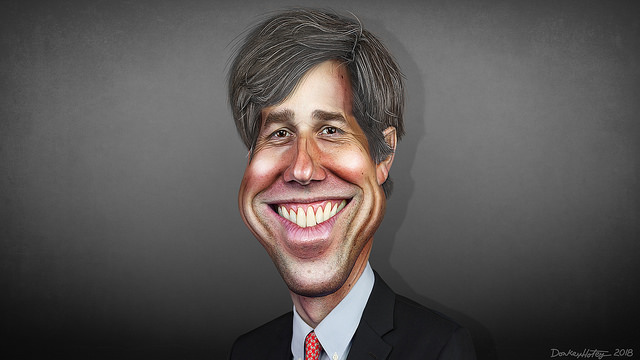
Your U.S. Sentaor from Texas, Rafael Edward Cruz (he goes by Ted), has drawn an excellent and serious opponent this year, the sitting congressman from Texas’ 16th Congressional District, Robert Francis O’Rourke (he goes by Beto). The 16th District includes El Paso and my old home away from home, Fort Bliss.
A photocaricature of Robert Francis O’Rourke by DonkeyHotey with permission under Creative Commons agreement. See more of his work on his Flickr site at https://flic.kr/p/25xUjna
I have made a monthly pledge to his campaign through November. When I wake up in the middle of the night in a major fret over the state of the world, I remember that I am helping this man make more ads like this one. I go back to sleep and dream about a Texas that gives me a voice in Congress.
It was fun while it lasted. President Obama understood the principles and mechanics of constitutional government and he approached the job with the highest ethical standards. And, although one may differ with his policy direction, it cannot be credibly argued that he failed to perform the job of President of the United States with distinction.
That is history. The Democratic Party is now faced with trying to regain a modicum of power in our tripartite system so as to be able to exercise the balance of powers the founders counted on to protect against the concentration of too much power in the hands of one person or party.
How did the Democrats lose power and what can be done to win back a seat at the table of American governance?
The loss of power is not something that happened suddenly in 2016. Although we will apparently be sorting through the problems related to that election for some time, we will not find the answer there in why Democrats don’t compete well in most states today.


 South of Town: Notes and Scenes from Texas' Upper Gulf Coast