A few days ago, a strange instrument of polity we United Methodists created to resolve – hopefully once and for all – the question of the denomination’s acceptance of gay clergy and the blessing of same-sex marriages met and failed. Without going into all the details, suffice it to say that the special session of the General Conference “resolved” the issue by emphatically endorsing existing language of the Book of Discipline that forbids the ordination of gay clergy and prohibits any ordained member of the clergy from officiating marriages for same-sex couples.
This all started in 1972 with the insertion of language into the Discipline of a statement meant to support the rights of gay members in the church and in society. However, conservatives at that General Conference succeeded in capping it off with following additional clause: “…although we do not condone the practice of homosexuality and consider this practice incompatible with Christian teaching.”
To the contrary, it is this exclusionary provision that is more likely incompatible with Christian teaching in the estimation of most 21st century United Methodists in America. Most of us see it as wrong to pretend that God’s love and the grace of Jesus Christ is somehow less available to people who express their love and commitment to each other in relationships that do not conform to 19th and 20th century ideas of acceptability.
I grew up in the South in segregated neighborhoods, schools, and churches. I was born in 1943. The world was in violent upheaval across Europe and in the Pacific. That year, Dr. Martin Luther King, Jr. was finishing high school and preparing to enter college at the age of 15.
I can’t remember when I first heard of Dr. King but I think it was probably a six o’clock news report of one of the bombings of Dr. King’s home. Or maybe I saw him on the cover of Time magazine or television during the Montgomery bus boycott. 1957 was an eventful year in the life of Dr. King and in the life of our nation. When they were happening, these events didn’t make much of an impression on a white teenager from Houston’s blue-collar ship channel neighborhoods. I was in my middle teens and not as precocious as the young Martin, so the events of the day didn’t move me the way they would when I read about them later in my life.
At that age I was more interested in Houston Buffs and socializing with my church youth group than I was in the evening news. You may think that the brutality and injustice suffered by American citizens across the South would have gotten even a kid’s attention. But we white kids suffered from a vision problem that kept us from seeing the world of privilege we lived in and the injustices it had been built upon.
When I was a kid we listened to Sergeant Preston of the Yukon on the radio. If you ever listened to Sergeant Preston on the radio, you know that he sometimes got lost in the snow. Everything was white. The ground was white. The sky was white. Even the Yukon River was white. Everything ahead was white. Everything behind was white. White to the left. White to the right. He was blinded by the whiteness. Like Sergeant Preston, we had been snow-blinded.
We offer our thanks today for the gift of a story of a baby born in Bethlehem whose own offering of grace and love has sustained us for centuries and given us hope and strength to overcome murderous dictators and those who have brokered power through violence.
We give thanks for our own free press and reporters like Nicholas Kristof who recently forced us to look see the image of Abrar Ibrahim whose starvation in Yemen at the hands of powerful men, able to give her the needs of life but use her instead as a pawn in struggles for power. The image of a 12 year old girl who weighs 28 pounds on a planet of plenty gives us no room for excusing ourselves. And, in her misery, she represents millions of suffering children and adults. Continue reading “A Prayer at Christmas”
We humans love being agreeable. It is so much easier than constantly finding ourselves in arguments and having to defend our positions. It also beats having small groups of people turn sidelong glances your direction as if caught talking about you and your “different” way of viewing the world.
That’s why people love bandwagons. If you see one leaving the station, hop on for the ride. You will be in the company of pleasant people who ask nothing from you except your soul. That’s right. Just go with the crowd, be a good snake oil consumer, buy into self-serving political programs and don’t bother the driver with questions about where we are going. There’s a party going on in the back of the bus.
American politics thrives on bandwagons. All politics thrives on bandwagons. One could argue that any political system, over time, will come to reflect the social consensus in which it operates. And while we can bring illustrations from history that would seem to prove the point we must recognize that consensus, itself, is manipulable. Astute politicians have learned how to use the bandwagon effect to manipulate a society’s consensus and, hence, a political system’s drift, direction and policy output.
I am like any other consumer of media, I suppose, with my own bandwagon of reporters and friends in what conservative commentators like to call the left wing media.Yes, the New York Times, the Washington Post, MS-NBC, NPR and The Guardian are sources I trust much more than the White House and its Fox News friends. My choice of media reflects my view that truth is an essential component in our politics.. Truth is a value of the left and seemingly of little concern to the political right. They have learned to play the realpolitik of the classic dictatorships where truth is an ethical drag on the business of achieving and holding power. Continue reading “Trump’s Bandwagon Hits the Road”
The United Methodist Church I attend has joined the discussion of the issue that the denomination has battled over since 1972 when the General Conference of the church decided that homosexuality was “incompatible with Christian teaching.” You know, like war and torture. Almost fifty years later we are still engaged in the battle.
As I listened to the discussion at Chapelwood last Sunday I couldn’t help but think of the deal with the devil our Founders made in drafting the United States Constitution: accepting slavery as the price of unification. Unification was ultimately achieved with terrible loss of life. And we have yet to achieve full freedom and participation for the descendants of the people who were brought here and who worked against their will for the enrichment of the European immigrants. Continue reading “Methodists: Could We Just Get on with the Great Commission?”
By the time most people hit their teen years they begin to grapple with the question of meaning. It is one of the main questions we take with us to college and into careers. Was there ever a college freshman who didn’t ask “What is the meaning of life?”
At the end of this month I will celebrate my 75th birthday. And I am still searching.
Some of us never find an answer that is fully satisfactory. Yet the question itself betrays a faith that there is, or at least should be, some meaning in our lives. As a practicing United Methodist, I finally submitted to regular attendance at that Methodist invention called Sunday School after resisting for many years. I became part of a small group at Chapelwood UMC that settled on a curriculum called “Living the Questions.” We don’t presume that there is a literature that will give us all the answers to questions of faith. We look for studies that will help us learn how to live out the faith that brings us, in the first place, to the question of meaning in our lives,
Although we may resist admitting to definitive answers to the questions of faith, sometimes an answer sneaks up on us that won’t let go. And it is compelling enough that we feel an urge to put it into action in our lives. It may be something as simple as this: loving and living in community. In fact, that pretty well sums it up for me after these nearly seventy-five years of searching.
Of course we can examine that proposition another 75 years trying to unpack all that is implied by loving and living in community. But it isn’t that difficult to set it in motion in our lives.
There is a prayer of confession in our liturgy of Holy Communion that helps me fill in the blanks each time I hear it.
Merciful God, we confess that we have not loved you with our whole heart. We have failed to be an obedient church. We have not done your will, we have broken your law, we have rebelled against your love, we have not loved our neighbors, and we have not heard the cry of the needy. Forgive us, we pray. Free us for joyful obedience, through Jesus Christ our Lord. Amen.
Every time I hear it, I wonder how it is possible to pray such a confession without looking deeply into our politics. After all, to truly love our neighbors and respond to the cry of the needy, we need to move beyond symbolic service that fails to address systemic issues like immigration, poverty, abuse, homelessness, addiction and unemployment. We certainly provide help and loving care to a family when we pay a utility to keep them in housing for another month. But it is our vote that makes it possible to address the larger underlying problems that these families experience.
And how does it all make sense in a world that has the gift of science to help us understand social and environmental problems? Is “talking to God” really a useful tool when we really need to be talking to the conflicted and corrupt politicians who have the power to do something? How does all this talk of a spiritual reality fit into what we know from science?
Our young associate pastor, Rev. Josh Lemons, gave a remarkable sermon this last Sunday at Chapelwood. He is doing a series on “Thinking for Christians.” The second sermon in his series was titled Faith Seeking Understanding. (The podcast is linked here.)
Josh is young, energetic and he has obviously learned something about the value of kinetic communication. He was all over the place Sunday. Please note that when you listen to the podcast, you will not be aware that he fakes a toss of a can of green beans into the congregation or that the climbed and stood on top of a tall four-legged stool to illustrate the Wesleyan quadrilateral concept: how scripture, tradition, reason and experience are all required in the analysis of our troubling theological questions if we are to have a stable base of support.
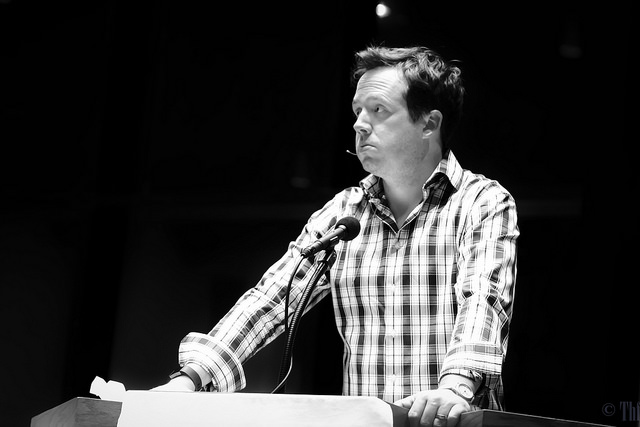
Rev. Josh Lemons, Associate Pastor, Chapelwood United Methodist Church. In this photograph, he was rehearsing for the confirmation service that would take place the following Sunday.
Chapelwood is an interesting place for Christians who need room to allow reason and experience to instruct the questions of the spirit. And when I hear ideas like these discussed from the pulpit, I feel freed for joyful obedience.
I invite you all to Chapelwood and to our Living the Questions class. The class meets at 9:45 am Sunday and the worship services are at 8:30 and 11. We always have good coffee – fair trade from Equal Exchange.

 South of Town: Notes and Scenes from Texas' Upper Gulf Coast