
A great friend and photographer, Ed Christman, passed away June 30 after battling with Parkinson’s for many years. A few years ago, after his tremors became profound and disabling, he had a surgical procedure that helped some but it could not protect him from the continuing ravages of the disease and time.
Ed was my photography mentor. I met him sometime in the 1980s or 90s when he was Dow’s head photographer. I worked at United Way and we needed a volunteer to help us with our color brochures and other campaign graphics.
I was surprised to learn that Ed didn’t mind talking to a family snapshot photographer about some of the finer points of getting good photos. He didn’t pretend that better equipment makes you better photographer. Mind you, as a corporate photographer, Ed had the good stuff but it was apparent to anyone who watched him work that his genius was in positioning, distance, relationship with human subjects, ability to read the light and a lot of other things that the camera can’t do for you, at least not with the same degree of perfection as a human who understands his machine and knows how to make it do what he wants it to do.
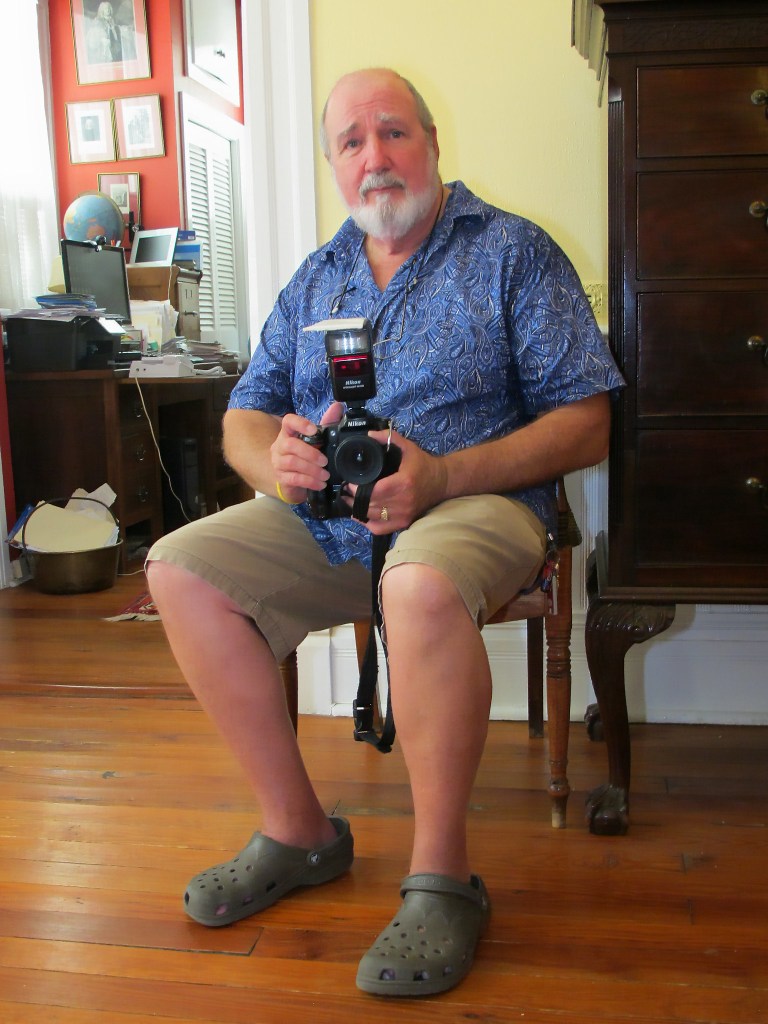
This is a photo of Ed I took eight years ago when we worked together on some publicity shots for “Dividing the Estate,” a Horton Foote show being produced by Brazosport Center Stages. I felt happy to tag along with Ed, mostly to see how he went about his work. You will notice in the photograph that he has adorned his flash with that photographer’s cheapest and most cost-effective gadget, an index card flash reflector. But he did have the nice Nikon gear. I followed him around with my little point-and-shoot (a pretty nice one actually – the Canon Powershot G11) and got a few fair shots. Ed’s, of course, were spectacular.
The things he did with light outdoors gave me an education in the possibilities for softening natural light on sunny days. His interaction with people who were posing for him struck me as being icing on the Nikon cake. Equipment alone could not explain the cooperation he got from the play’s actors. He didn’t ask people to say cheese, he made them feel happy to be on the other side of the lens from such a genuinely nice and happy man.
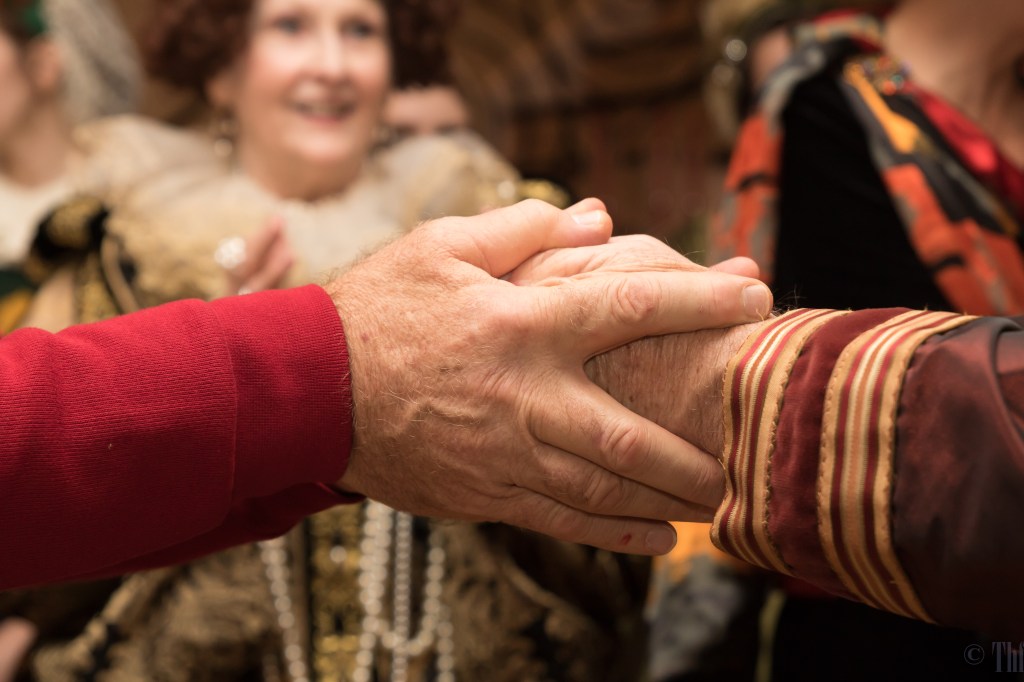
There wasn’t a lot of energy in him for show photography after that. He came out to The Center in November that same year to take some publicity shots for the Elizabethan Madrigal Feast. He allowed me to post a few of them on my Flickr site so others could view them. He was a little too early for Instagram and all the online toys that photographers like to use now. But he was happy for me to put some online for the cast to see. They are all carefully attributed to Ed. I do that even though it would be apparent to anyone that the difference between his shots and mine would quickly show me up as a photo-plagiarist. Here are a couple of Ed’s shots from that November EMF shoot.

I was stunned by the beauty of his work. Here is the steward bearing the wassail. And, then, there is this Dutch master. I found this one to be simply breathtaking.

When our son got married in 1999, we asked Ed to do the wedding. That, if you remember, was back when photographers used film. What Ed did with that film was remarkable.
Nor was there anything fake or plastic about Ed’s presentations. No scrapbooks, silver frames, special sets for Grandma and Grandpa. All you got from Ed were packets of prints and negatives. No watermarks. No special permission for reprints. No proofs to pick from.
I will never forget when he came to our house after the wedding with about twenty packages of color prints and negatives. He left them with us. That was his total presentation. I asked if he wanted us to go through them and pick some for final printing.
“No, they are all yours. You may print as many as you wish.” He recommended a local photo printer who could give us any size, matte or glossy, and who had scrapbooks, mailers, frames, etc.
He left and we started to go through the envelope – twenty envelopes, each with 36 exposures. They were almost all beautiful photographs. I don’t think there were half a dozen throwaways in the whole batch. The man wasted no film. It was one of the most amazing things I had ever seen.
He had no need for PhotoShop. In fact, his wife has told me he detested it mightily. His philosophy was that you should do it right when you open and close the shutter. And sure enough, all but a few were perfection. He made a precise exposure and an elegant, perfect composition with each frame. I am still in awe of his art and his skill in coaxing the best work out of the camera.
We had one more wedding to go after that. Needless to say, we asked Ed to do it again. By then he had moved to digital. I have also stored a few of those on my Flickr site. Again, his art is at another level. Those wedding photographs he took of our children have given us anchors in time on two of our happiest days. Ed was able to see those life events with the same intensity of feeling that the parents felt on those days and he captured them for us to enjoy for all these years. All these years later, they live on.
Ed was a photographer trapped in a literary family of writers, teachers, and actors. I don’t know which of them was the primary author of his obituary, but whether by the Christman team or one individual author, they have said it best:
While raising his family, Ed became one of the most popular photographers of Brazoria County. Early evenings—when the light was perfect—weekends, and holidays were filled with portraits, weddings, celebrations. Attired in a utility vest and a broad-brimmed hat, he captured moments of joy, solemnity, achievement, honor, camaraderie, daring, and love. Ed taught people to see, to focus on the light in the eyes, to find a person’s best angle, and—as light does—to illumine the beauty sometimes concealed by shadow. In his art, whether a portrait, a candid shot, a cityscape, an industrial, a shell in the sand, or an old oak draped in Spanish moss at dusk, Ed found the uncanny perfection hidden in plain sight. He showed us ourselves and our world as only he could see them.
We miss Ed’s presence in our community. But he has captured time for us in photography’s special way. We see the images and we feel those moments again. Thank you for those treasures, brother Ed.



 South of Town: Notes and Scenes from Texas' Upper Gulf Coast