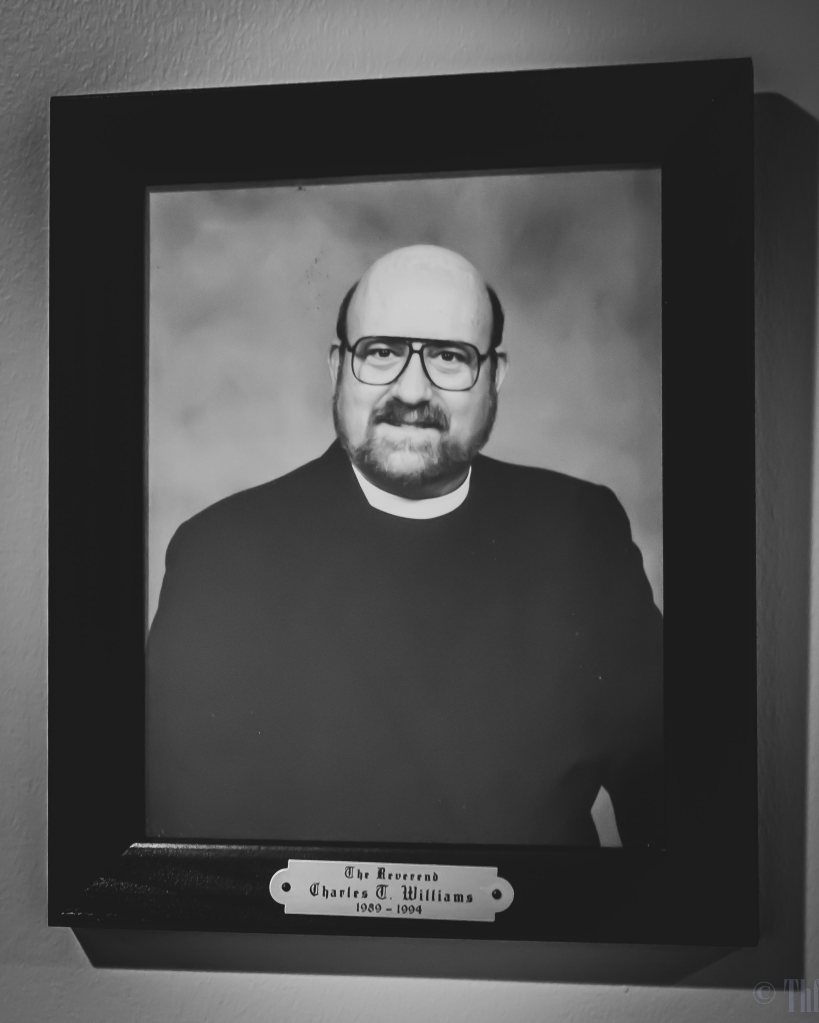
Remembering Father Williams

Father Charles Williams (Rector of St. Barnabas Episcopal Church Denton, Texas, 1989-1994) had a keen interest not only in setting the intellectual tone of the parish but also in enhancing its artistic environment. The emphasis on the arts was most appropriate, for the parish served as a place of rehearsal, performance, and research for fine arts students, especially from TWU, for many years. Father Williams encouraged the remodeling of the altar area. After his death, the parish published a book of his sermons. Though known for his intellectualism and quiet nature, Father Williams also provided a good laugh. After telling the children at a Blessing of the Animals ceremony that pets did not go to heaven, he was petitioned by the children to reconsider. By that point, he had acquired a much-loved dog and deemed that pets did, indeed, go to heaven.

From the history of St. Barnabas Episcopal Church (Denton, Texas) posted on the church’s web site: https://stbarnabasdenton.org/about-us/history/
Father Charles Thomas Williams served as Rector at St. Barnabas Episcopal Church from 1989 until his death at the age of fifty in 1994. He was my friend in college and best man at my wedding.

The parishioners at St. Barnabas Episcopal Church in Denton, Texas, must have thought it rude for a tourist to show up just before the morning service Sunday (February 23) as the congregation gathered for worship. My wife and I were just starting our trip back to Lake Jackson after spending Saturday watching our granddaughter compete in a gymnastics meet. We had discussed the possibility of looking up the church in Denton where my college roommate and our best man had served as rector until his death in 1994.

I was was pretty sure I would not enjoy being among strangers, most of whom would be too young to know my friend and none of whom, certainly, would know the Charles Thomas Williams I knew in college at the University of Houston. Moreover, I didn’t want our presence to be disruptive of the worship environment.

“But there may be a memorial of some kind and we could at least look around the outer grounds,” my wife argued. I acceded and she parked the car while I strapped my monster camera around my neck, slapped on my big Stetson crushable, and did my best to look like anything but a person hoping to be drawn into conversation with an Episcopalian in a worshipful mood.

Continue reading “Remembering Father Williams”

A Sign of Things to Come: Opening Day at Enron Field, April 7, 2000.

Photograph from Federal Bureau of Investigation public domain collection posted on Flickr.

Houston’s heart has been broken by corporate scandal twice just twenty years in the 21st Century, once last week by the Houston Astros and in 2001 by the Enron Corporation. If you felt no grief for Enron, then you didn’t know personally any of the people who worked there. They were engineers, clerks, and HR folks like you would find at any other company around Houston. They stood out as innovative, productive employees and good citizens. Most of them had the reputation of being smart, generous and kind.There were only a few bad apples and they worked at the top of the chart.

Our hearts were broken again by our Astros. The sign stealing scandal has forever stained our memories of the beautiful gift of a World Series championship for a city that had suffered a Category 4 hurricane and catastrophic floods in August of that year. It was the year of Harvey and this was a team that brought joy to a hurting city. They were beautiful to watch on the field. They played with excellence and they behaved like the nicest kids you would ever know.

At least we thought so. Continue reading “A Sign of Things to Come: Opening Day at Enron Field, April 7, 2000.”

The President Discusses Wind Energy with Young People

The president addressed a group of young voters yesterday at something called the Turning Point USA Student Action Summit in West Palm Beach, Florida. I have copied his remarks from the White House web site where you may read the entire official transcript. His remarks follow:

We’ll have an economy based on wind.  I never understood wind.  You know, I know windmills very much.  I’ve studied it better than anybody I know.  It’s very expensive.  They’re made in China and Germany mostly — very few made here, almost none.  But they’re manufactured tremendous — if you’re into this — tremendous fumes.  Gases are spewing into the atmosphere.  You know we have a world, right?  So the world is tiny compared to the universe.  So tremendous, tremendous amount of fumes and everything.  You talk about the carbon footprint — fumes are spewing into the air.  Right?  Spewing.  Whether it’s in China, Germany, it’s going into the air.  It’s our air, their air, everything — right?

So they make these things and then they put them up.  And if you own a house within vision of some of these monsters, your house is worth 50 percent of the price.  They’re noisy.  They kill the birds.  You want to see a bird graveyard?  You just go.  Take a look.  A bird graveyard.  Go under a windmill someday.  You’ll see more birds than you’ve ever seen ever in your life.  (Laughter.)

You know, in California, they were killing the bald eagle.  If you shoot a bald eagle, they want to put you in jail for 10 years.  A windmill will kill many bald eagles.  It’s true.

And you know what?  After a certain number, they make you turn the windmill off.  That’s true, by the way.  This is — they make you turn it off after you — and yet, if you killed one they put you in jail.  That’s okay.  But why is it okay for these windmills to destroy the bird population?  And that’s what they’re doing.

AUDIENCE MEMBER:  Because they’re idiots!

THE PRESIDENT:  (Laughs.)  This is a conservative group, Dan.  (Applause.)  No, but it’s true.  Am I right?  (Applause.)

I’ll tell you another thing about windmills.  And I’m not — look, I like all forms of energy.  And I think (inaudible) — really, they’re okay in industrial areas.  Like you have an industrial plant, you put up a windmill — you know, et cetera, et cetera.

I’ve seen the most beautiful fields, farms, fields — most gorgeous things you’ve ever seen, and then you have these ugly things going up.  And sometimes they’re made by different companies.  You know, I’m like a perfectionist; I really built good stuff.  And so you’ll see like a few windmills made by one company: General Electric.  And then you’ll see a few made by Siemens, and you’ll see a few made by some other guy that doesn’t have 10 cents, so it looks like a — so you see all these windows, they’re all different shades of color.  They’re like sort of white, but one is like an orange-white.  (Laughter.)  It’s my favorite color: orange.  (Applause.)

No, but — and you see these magnificent fields, and they’re owned — and you know what they don’t tell you about windmills?  After 10 years, they look like hell.  You know, they start to get tired, old.  You got to replace them.  A lot of times, people don’t replace them.  They need massive subsidy from the government in order to make it.  It’s really a terrible thing.

A Thought for the Democrats in Congress

Why stop at two articles of impeachment? The president is addicted to superlatives. He could be the president remembered for the MOST (caps, of course) documented and prosecuted impeachable offenses in a truncated term in office.

He would take that as the equivalent of a reality television Oscar. Maybe Speaker Pelosi could hand him a statuette of Oscar (the Grouch) along with a six volume condensed set of impeachment resolutions. He would be so thrilled that he would start planning his presidential library with some books that, having lived them, he could not be criticized for failing to read.

November 21, 1963

Late November in one of my happiest years:

we wrapped ourselves in the soft thrill of friendship

not knowing how rare it was and how hollow -

for lack of it - would be the days and years ahead.


Chattering with the sophistication of underclassmen

we crossed a vacant city lot grown over with weeds,
toward the road that exited the airport.

The young president and his wife had landed and would

pass here on their way to speak in Houston.


His red hair flamed

in the late afternoon Texas sunlight. 


He waved and each of us stored the memory

of an instant as the car sped by, 

the woman at his side,
 his shining hair,
the slightest wave of his hand, 

the memory – a still photograph in each of our minds.


In less than a day, he was dead;
hit by two rifle shots. His wife was returning,

spattered with his blood
to the emptiest of homes, the White House.


Another memory – but this one with the remove

of miles and overwritten with the static snow
from our 
early technology television sets.


Those same sets had been on that morning before he died

as we searched to see if there would be news of his visit.
Maybe a camera had caught us as well
and our friends would see us so close to history.
Instead, we saw four floppy-haired singers
from Britain who were planning a visit to America. 


A few hours later, there was only the news 
that the man
on whom we had hung our hopes was dead.


Friendships that we thought were the most precious
gifts 
in our lives that day,
faded with the years.


Each of us had lives to live, purpose and gifts to give. 


The floppy-haired Brits gave us the happy crutch 

we needed to weather war and loss,
and, not least,
 the death of that soft thrill of friendship
we still had heart to feel
on November 21, 1963.

Bad Politics, Even Worse Entertainment

From the New York Times. An actor evaluates DJT as an entertainer, which is his true ambition.

www.nytimes.com/2019/10/16/opinion/john-lithgow-trump.html